AI Search Optimization – Part 1
What We Know, What We Don’t, and How Businesses Should Prepare
As anyone in the marketing industry could tell you, the top talk has been about AI search. Almost every client I work with has approached me with some variation of the same question about how to show up in AI search. This is a somewhat difficult question to answer because there is still so much that is unknown. That’s not to say you should just sit on your hands and hope for the best, though.
Over the course of several posts, I’m going to lay out what we know, what we don’t know and some specific things that businesses can do to improve their chances of showing up. My goal is to make these posts based on as much fact and reality as possible. I’ve been accused of being cynical and a skeptic, and maybe that’s true, and in this case, I believe that cynicism is what’s needed to keep things in perspective.
This first post will focus on some of the basics about what we actually know and where things seem to be headed based on those facts and not on conjecture or the “flavor of the week” method that some agencies or supposed “experts” attempt to sell.
With that said and out of the way, let’s get started.
The Current State of AI Search
Over the past couple of years, artificial intelligence has started to change the way people search for information online. Instead of typing a question into a search engine and scrolling through a list of links, many users are now getting direct answers from AI tools that summarize information from across the web.
And this shift is happening quickly.
Recent research suggests that about half of consumers now use AI powered tools in some form when searching for information, and roughly a third of users say they sometimes start their searches with an AI assistant instead of a traditional search engine. Adoption has grown rapidly as well. In early 2024, about one quarter of internet users reported using generative AI tools, but by late 2025 that number had grown to nearly half of all users online.
At the same time, platforms like ChatGPT are processing billions of prompts every day, showing just how quickly conversational tools are becoming part of everyday online behavior.
For businesses that rely on search visibility, this raises an obvious question: how do you make sure your content shows up when AI tools are answering questions?
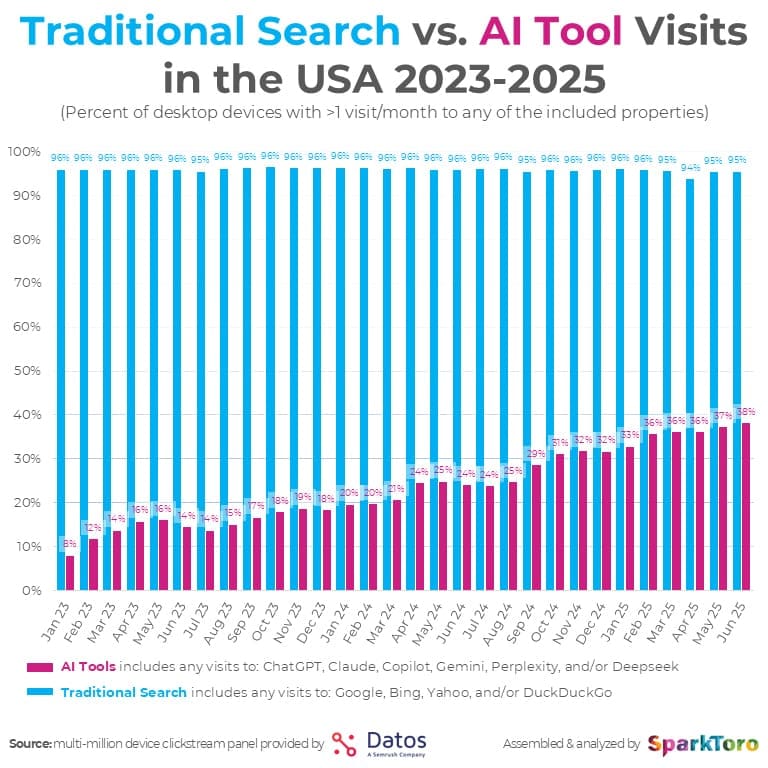
The truth is that the industry is still figuring that out. Similar to search engines, AI companies don’t publish a list of the specific factors they take into consideration. There are plenty of unknowns, but there are some patterns emerging.
Search Behavior Was Already Changing
Before getting into some specifics on AI, it’s important to understand that search behavior was already shifting prior to when generative AI answers started appearing.
Studies of Google clickstream data found that around 65 percent of Google searches end without a click to a website. On mobile devices, that number climbs even higher, with more than 75 percent of searches ending directly on the search results page.
In many cases, users are getting the information they need from things like featured snippets, knowledge panels, or quick answers without ever visiting a site.
AI generated answers take this idea even further.
Instead of pulling a single snippet from one page, AI systems summarize information from multiple sources and present it as a conversational answer. That can make the search experience faster for users, but it also means fewer opportunities for businesses to earn a click.
Early studies suggest that AI generated answers can reduce clicks to traditional search results by anywhere from 18 percent to more than 60 percent depending on the type of query. Informational searches tend to be the most affected because AI tools can summarize explanations quickly.
That does not mean search traffic is disappearing overnight, but it does mean the way people interact with search results is evolving.
AI Search Is Growing Quickly
Even though Google still dominates search traffic, AI powered search tools are gaining traction.
ChatGPT alone now receives billions of visits per month, while other tools like Perplexity and Microsoft Copilot are estimated to be processing hundreds of millions of queries. These platforms are introducing new ways for users to ask questions, refine results, and explore information.

The result is that search is starting to fragment across different tools and platforms.
This trend is especially noticeable among younger users. Some studies have found that nearly 40 percent of Gen Z users say they sometimes prefer alternative tools such as social platforms or AI assistants when searching for information online.
At the same time, user attitudes toward AI remain mixed. Surveys suggest that many people believe AI will bring meaningful benefits, but fewer than half say they fully trust AI generated information.
That combination of rapid adoption and cautious skepticism makes the current moment particularly interesting for businesses trying to understand how AI will influence search in the years ahead.
What We Know About AI Search Optimization
Although the technology is evolving quickly, a few important patterns are starting to emerge.
First, most AI search systems still rely heavily on the existing search ecosystem. Using a system called retrieval-augmented generation, AI tools often retrieve information from websites that already rank well in search engines or come from trusted sources.
Second, AI models appear to favor content that is clear, well structured, and easy to interpret. Pages that explain topics directly, answer common questions, and present information logically are more likely to be used when generating responses.
Third, authority still matters. AI systems tend to rely on websites that demonstrate expertise in a particular topic area. Sites that consistently publish high quality content on a subject appear more likely to be referenced.
None of these principles are especially new. In many ways, they reflect the same fundamentals that have guided search optimization for years. The difference is that now the audience includes not just human readers and search engines, but also AI systems that are analyzing and summarizing web content.
What We Still Don’t Know
For all the discussion around AI search optimization, there are still many open questions.
For example:
- How often will AI systems cite specific websites when generating answers?
- How will AI generated responses affect long term traffic patterns?
- What signals determine which sources are used when AI summarizes information?
- How will different AI platforms evaluate authority and credibility?
- How frequently do AI systems analyze the web for new information?
The reality is that the technology is still evolving, and different AI platforms may take very different approaches to generating answers. Because of that uncertainty, it is important for businesses to avoid jumping to conclusions or chasing trends that have not yet been proven.

A Word of Caution About AI Search “Experts”
Whenever a major technology shift happens, there is usually a wave of people claiming to have already figured it out. AI search is no exception.
I saw this trend in my early years of SEO. It seemed like every week one of the so-called experts would have a new trick or tactic to get a site to rank well. I’ll admit, I fell into some of this when I was new. I eventually figured out that none of these people really knew anything more than I did. They were just fishing for clicks and a way to make a buck.
You will likely start seeing that process start over with agencies and consultants promising guaranteed rankings in AI results or offering proprietary “AI SEO strategies” that supposedly unlock special advantages.
The truth is that no one fully controls how AI systems generate answers, the rules are still changing, and the true ranking factors are unknown.
That does not mean businesses should ignore AI search. It simply means that the most responsible approach right now is to focus on strategies that align with the underlying principles of search: creating useful content, demonstrating expertise, and making information easy for both humans and machines to understand.
I’m not going to claim I have the magic answer. And anyone promising instant dominance in AI search results or claiming to be an expert should probably be approached with a healthy amount of skepticism. It probably goes without saying, but anyone with “one weird trick” should be avoided.
Preparing for the Future of Search

Even though the exact future of AI search is still taking shape, there are already steps businesses can take to position themselves well.
In many cases, those steps build on things that strong websites are already doing. Clear content structure, strong topical authority, trustworthy information, and solid technical SEO all help make content easier for AI systems to find and interpret.
Rather than replacing traditional SEO, AI search optimization appears to be an extension of it. Businesses that focus on high quality content and clear expertise are likely to be in a much better position as AI tools continue to evolve.
What This Series Will Cover
Over the next several articles, we will take a closer look at the strategies that appear to matter most for visibility in AI driven search environments.
Topics will include:
- How AI search engines find and use website content
- Writing content that AI systems can easily understand
- Why topical authority is becoming more important
- The role of structured data in helping AI interpret your site
- Why traditional SEO still matters in the age of AI
- Content formats that perform well in AI generated answers
- Trust and credibility signals that influence AI responses
- Entity optimization and knowledge graphs
- AI search considerations for local businesses
- Measuring visibility in AI driven search environments
Each post will attempt to provide practical insights that businesses can use as the search landscape continues to evolve.
Don’t Panic
Artificial intelligence is shaping up to be one of the most significant changes to online discovery since the rise of modern search engines. The technology is moving quickly, and there are still plenty of unknowns about how AI search will develop.
What is becoming clear, however, is that the core principles of strong digital content still apply. Businesses that provide useful information, demonstrate real expertise, and make their content easy to understand will likely be the ones that benefit the most as AI continues to reshape how people find information online.

As with many shifts in technology, the best strategy is not to panic or chase shortcuts, but to focus on building a strong foundation that will hold up as the tools continue to evolve. So, grab your towel and let’s dig into AI search together.