Home service companies don’t fail because they lack technical skills. They fail because potential customers never find them. Whether you own an HVAC company, a plumbing business, a roofing company, or an electrical service, your growth depends on one thing: generating consistent, qualified leads that you can turn into paying customers.
The challenge is that most home service companies approach marketing reactively instead of strategically. They run random ads, post inconsistently on social media, occasionally send emails, and hope referrals continue to carry the business. That approach may sustain a business for a while, but it rarely creates scalable growth.
At EdwardsSchoen, we build and implement marketing strategies for home service companies designed to generate leads consistently, strengthen local brand recognition, improve customer retention, and maximize return on ad spend.
In this guide, we reveal the key elements of a high-performing marketing plan for a home service company, including the tactics and timelines, budgets that drive measurable growth.
Why Home Services Require a Different Marketing Strategy
Marketing for home service businesses is unique because customers often search with urgency. Someone searching for:
- “Emergency plumber near me”
- “AC repair open now”
- “Roof leak repair company”
- “Electrician in [city]”
…is usually ready to buy immediately. That means your marketing strategy must accomplish three goals simultaneously: generate immediate demand; build long-term brand awareness; create recurring customer relationships.
The most successful home service companies understand that marketing is not a one-time campaign. It is a comprehensive ecosystem.
Want to stay up to date with the news and resources from EdwardsSchoen?
Sign up for our monthly newsletter to stay in the know!
Step 1: Define Your Business Goals
Most home service companies say they “want more leads”, but that’s too vague. Instead, a strong marketing plan begins with measurable business objectives. These could be lead generation goals, revenue goals, brand goals, or retention goals. Some examples include increasing annual revenue by 20%; increasing average ticket size by 15%; generating 100 more qualified leads per month; or being the most recognizable AC company in the city.
Make sure all company decision-makers are included in these decisions. Ask yourself if they are reasonable. Do they align with your overall company mission? Wanting to achieve a goal and knowing you have the infrastructure to achieve it don’t always match up.
Step 2: Identify Your Ideal Customers
Not every lead is a good lead. The best home service marketing plans identify exactly who the company wants to attract and why. This include assessing neighborhoods and service areas, the type of sale or value of sale you want to achieve and knowing what services you offer that meet those needs. A good practice to implement when identifying your ideal customers is to build customer personas. Once the company’s personas are defined, message become significantly more effective and clearer.
Example: HVAC Customer Persona
Name: “Busy suburban homeowner”
Characteristics:
- Age 35–55
- Dual-income household
- Owns a home older than 10 years
- Concerned about comfort and reliability
- Searches Google during emergencies
- Values trust and fast response times
Step 3: Build a Strong Brand Foundation
Many home services companies underestimate the power of branding. Customers are inviting you into their homes, so trust matters. Building a strong brand helps homeowners feel confident before they ever call you to schedule a job.
Your brand consists of your visual identity, messaging (the words you use), and positioning in your industry. These elements should be clearly established and agreed upon by everyone in the business, and they should be consistent across every touchpoint that a customer could have.
Step 4: Optimize Your Website for Conversions
Even though home services companies aren’t always selling tangible items, your website is your digital storefront. And where most home service websites fail is in the conversion optimization. Yes, looking pretty is nice, but if it isn’t optimized to be a lead-generating machine, looks won’t matter.
Essential Website Elements
- Clear Calls-to-Action: Every page and many times on a page, web visitors should be encouraged to call now, schedule service, book now, or request an estimate.
- Mobile Optimization: Most home service searches happen on mobile devices, so your site should load quickly, be easy to navigate, feature many CTA buttons and have short forms to gather lead information.
- Service Pages: Each service you provide should have its own, dedicated web page. This makes it easier for search engines to find your content and return it to people searching for that content.
- Trust Signals: Your website should include reviews, testimonials, guarantees, awards, certifications, and financing options to let the visitor know you are trustworthy and safe to do business with.
- Local SEO Optimization: Your website should not be generic! The more local, search keywords you can include, the better. For example: Plumbing Experts in Kansas City.
Step 5: Create a Local SEO Strategy
As mentioned above, local SEO is one of the highest-ROI marketing channels. When homeowners search for services nearby, Google prioritizes businesses with strong local relevance. Creating a comprehensive local SEO strategy includes more than just a few local keywords on your website. Here is a list of local SEO tactics that should be used:
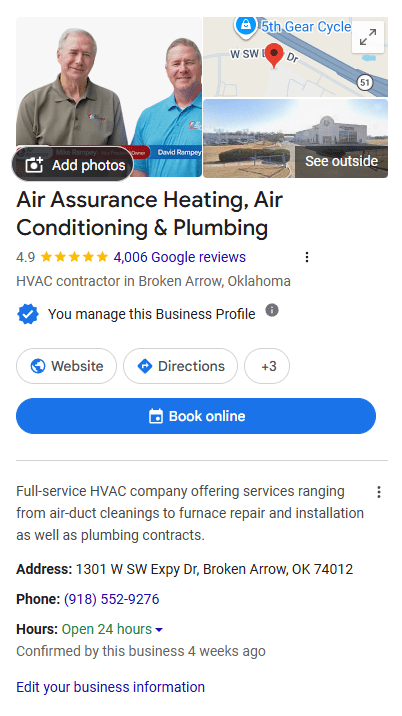
- An accurate and updated Google Business Profile
- Reviews, reviews, reviews—get more!
- Location pages dedicated to specific cities
- Blogs that delivers helpful content specific to your location
Step 6: Run High-Intent Paid Advertising Campaigns
SEO takes time, typically 90 days to 6 months before true traffic change is noticed from website edits. Paid advertising, on the other hand, generates leads immediately. The most successful home service companies use a combination of:
- Google Ads: Campaigns built to appear in Google search results targeting specific keywords for high-intent buyers actively searching for home services. Ex: emergency plumber near me
- Local Services Ads: These ads often generate some of the best qualified leads in the home services category; the ads appear above the traditional search ads and feature the Google Guaranteed badge
- Meta Ads: Social media ads to generate awareness and demand
Step 7: Build an Email and SMS Marketing System
Many home services companies focus only on acquiring new customers, which is expensive! Retention marketing done through email and SMS marketing systems offer the highest ROI opportunity.
In the home services arena, emails campaigns are often used for spring or fall tune-ups, membership maintenance plans, or financing reminders to customers who may want to upgrade expensive equipment before it breaks.
SMS campaigns are useful for appointment reminders and confirmation, requesting customers to leave a review, promotions for sales or special seasonal pricing, or maintenance reminders.
Step 8: Develop a Social Media Strategy
No, this isn’t about randomly posting photos of your team. This is about building credibility. Homeowners want to hire companies that appear active, trustworthy, and well-established. Creating a social media calendar that delivers educational videos, before and after photos of completed installations or services, testimonials and your company’s community involvement all contribute to building your brand and generating leads.
Step 9: Track the Right Metrics
One of the biggest marketing mistakes home service companies make is failing to track performance. If you do not know where your leads originate, you cannot scale effectively. Here are some examples of metrics to track and how you quantify them.
Lead Metrics
- Cost per lead
- Lead volume
- Call tracking
- Form submissions
- Booking rate
Revenue Metrics
- Revenue by channel
- Return on ad spend
- Customer lifetime value
- Average ticket size
Website & SEO Metrics
- Organic traffic
- Keyword rankings
- Google Business Profile Interactions
- Conversion rate
- Bounce rate
- Page speed
- Mobile engagement
Step 10: Build a 12-Month Marketing Calendar
The best marketing plans are proactive, not reactive. Seasonality plays a major role in home services. After you have identified and defined all the key elements above, now it’s time to create a calendar to implement these tactics at the right time in the appropriate order. Then assess, track, and watch over time how these tactics perform.
Why Home Service Companies Partner with Marketing Agencies
If you’ve read this far, then you can see the breadth and scope of tactics that go into a comprehensive marketing plan. Home service business owners already wear too many hats when it comes to managing technicians, customer service, recruiting and financing. This leaves very little time to build a sophisticated marketing strategy.
At EdwardsSchoen, our team of specialized marketers are ready to do this work for you. As an experienced agency, we understand how homeowners search, compare and choose service providers. This helps home service companies prevent wasted spend and experience accelerated growth. If your company is ready to generate more qualified leads, improve ROI, and build a scalable marketing system, give us a call.