
A Love Letter to the Top 10 Best (and Most Beautifully Weird) Swings in Baseball History
Baseball fans love debating greatness … Greatest player. Greatest team. Greatest World Series. Whether a hot dog is a sandwich.
But one topic has lost its luster the last 20 years or so: the baseball swing itself.
Not every great hitter had a pretty swing. Some looked like they were fighting off bees. Others appeared to be trying to chop down a tree. And a few — looking at you, Jeff Bagwell — appeared to be waiting for a surprise attack from a velociraptor.
These aren’t necessarily the greatest hitters ever. They’re the swings that made you stop what you were doing and watch. The swings that made batting practice look like art. The swings that made dads point at the TV and say, “See that? That’s how it’s done.“
So grab a hot dog, crack open a cold one, and prepare your angry emails — because after decades of playing, coaching and watching baseball, arguing with troglodytes, and pretending batting averages from 1987 still matter, here is my entirely unscientific, highly opinionated, occasionally sarcastic, thoroughly Xennial (and absolutely correct) list of baseball’s greatest swings.
Stan ‘The Man’ Musial – The Corkscrew Genius
If you’ve never seen Stan Musial hit, do yourself a favor. His stance looked like he was trying to peek over his shoulder at someone stealing his wallet.
Everything about it seemed wrong. Then the pitch arrived and suddenly it all made sense.
Musial’s unique coiled stance generated incredible leverage, helping him rack up 3,630 hits and become one of the greatest pure hitters ever.
Musial caused 74% of opposing pitching coaches in the 1950s to mutter, “What in the world is he doing?” immediately before giving up another double.
Fake Statistic
“The man’s stance looked like he was trying to hail a cab. Then he’d hit a double off the wall and jog to second like he had dinner reservations.”
An Unnamed Opposing Pitcher
Fred McGriff – The Epitome of Simplicity
The Crime Dog never looked like he was trying too hard.
No elaborate toe taps. No bat flips. No swing mechanics that required a NASA engineer to explain.
Just a smooth, compact stroke that produced 493 home runs and countless line drives.
Watching McGriff hit was like watching a master carpenter use a hammer. No wasted motion. No drama. Just results.
Which, ironically, made him one of the most underrated hitters of his era.

“McGriff didn’t beat you with tricks. He beat you the same way a freight train beats a shopping cart.”
Veteran Catcher to be Named Later
Jim Thome – The Uppercut From Heaven
Baseball’s leader in the clubhouse to Golf’s grip it and rip it! Jim Thome’s swing looked like it was built in a laboratory specifically designed to launch baseballs into neighboring zip codes.
Everything worked upward. Everything worked through the baseball.
When Thome connected, the ball didn’t merely leave the park. It filed a forwarding address.
His 612 career home runs weren’t accidents. Neither was the beauty of that swing.
“Jim didn’t hit line drives. He hit weather events.”
Anonymous AL Central Pitcher

“I spent three innings minding my own business. Then Jim Thome introduced me to low Earth orbit.”
Mr. Rawlings, a.k.a. The Baseball
Want to stay up to date with the news and resources from EdwardsSchoen?
Sign up for our monthly newsletter to stay in the know!
Gary Sheffield – Controlled Chaos
Technically speaking, Gary Sheffield’s pre-pitch bat waggle violated several laws of physics.
The bat moved so fast it looked like he was trying to swat invisible mosquitoes.
Young players were told for decades not to imitate it … thousands ignored that advice.
Yet somehow, once the pitch came, everything synced perfectly.
The waggle settled. The hands exploded. The ball disappeared.
Sheffield remains one of baseball’s greatest examples of “don’t teach this, but definitely admire it.“
Frustrated high school coaches everywhere
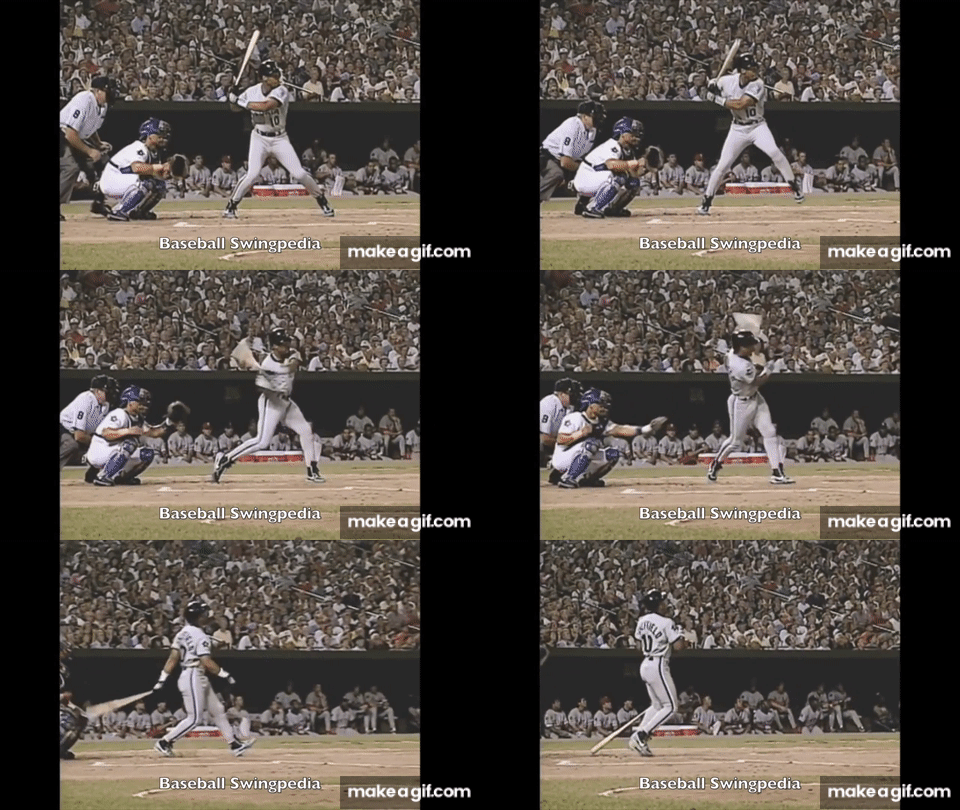
“Before every pitch, that bat moved around so much I thought I was having a seizure. Then he’d hit it 637 feet and I’d have one.”
A California Penal League Pitcher
Darryl Strawberry – The Smooth Criminal
Few swings combined elegance and power like Darryl Strawberry’s.
The long arms. The leverage. The effortless finish.
Everything looked easy. Maybe too easy.
The ball would jump off his bat and you’d wonder whether he even swung hard. He did. The baseball simply didn’t survive the encounter.
Strawberry’s swing remains one of the most aesthetically pleasing left-handed swings ever captured on video.
Until 1992 😉
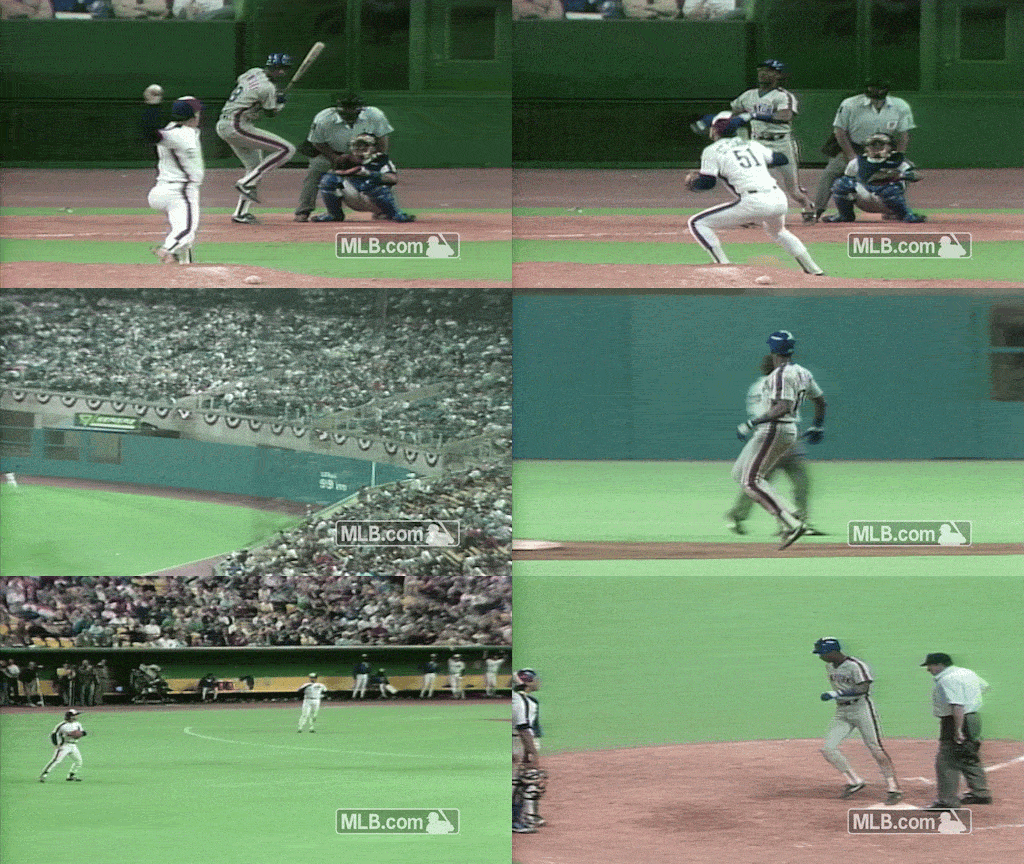
“The swing looked so easy I thought it was a pop-up. Next thing I knew I was turning around and apologizing to the wall.”
An Undisclosed Outfielder
Tony Gwynn – The Human Batting Tutorial
Plain ol’ sweetness.
Power swings get attention. Tony Gwynn’s swing deserves admiration for a completely different reason.
It was efficient. Balanced. Repeatable.
Gwynn seemed capable of placing a baseball anywhere he wanted.
Watching him hit was like watching someone play baseball on beginner mode while everyone else struggled on expert difficulty.
Some hitters swung for power. Gwynn swung for precision. And somehow made hitting .394 look reasonable.

“We watched six hours of film and found one hole in his swing. Turns out it was a smudge on the television.”
Hitting Coaches Doubting Themselves
Want to stay up to date with the news and resources from EdwardsSchoen?
Sign up for our monthly newsletter to stay in the know!
Barry Bonds – The Swing That Ended Conversations
Even before controversy clouded Bonds’ legacy; regardless of how you feel about the man himself, the swing itself was absurd.
Short. Quick. Devastating.
The efficiency bordered on unfair. By the early 2000s, pitchers often looked like people trying to disarm a bomb with oven mitts.
One mistake. Game over.
The swing wasn’t flashy. It was inevitable (hello, Thanos). Which may be even scarier.

“I haven’t seen my family since 2001.”
762 Baseballs
Albert Pujols – The Machine Disguised as a Human Being
Albert Pujols had one of the most explosive swings the game has ever seen.
No wasted movement. No extra flair. Just terrifying efficiency.
The swing looked compact until contact … then suddenly the baseball was traveling at approximately the speed of a tax refund disappearing.
Pitchers spent two decades trying to find a weakness. Many retired before they located one.
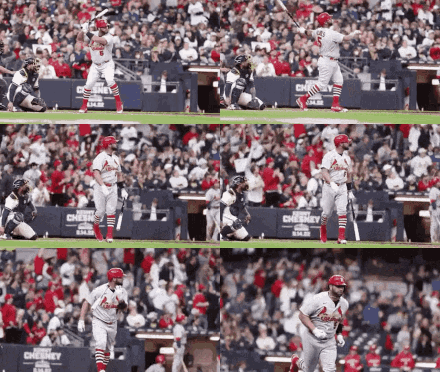
“Every scouting report said don’t throw him anything over the plate. Then you’d panic, throw it off the plate, and he’d hit that too.”
Any Pitcher. Any Level.
** fun fact 👇
Ken Griffey Jr. – The Gold Standard
Let’s be honest — you knew he was making this list. You probably knew he was making the Top 3, and possibly #1 … but alas, here we are.
Every generation gets a swing that becomes the benchmark. For Xennials, it was Griffey.
The stance. The load. The follow-through. The effortless power. It was baseball perfection.
Every backyard game featured at least one kid attempting the Griffey swing. None succeeded. Millions tried anyway.
Researchers estimate Ken Griffey Jr. is responsible for 87% of left-handed swings at Little League fields between 1990 and 2005.
Although Over the Top is a good bet, Junior is 1000% responsible for me turning my hat backwards in 1993 … and never looking back!
True Story from Yours Truly
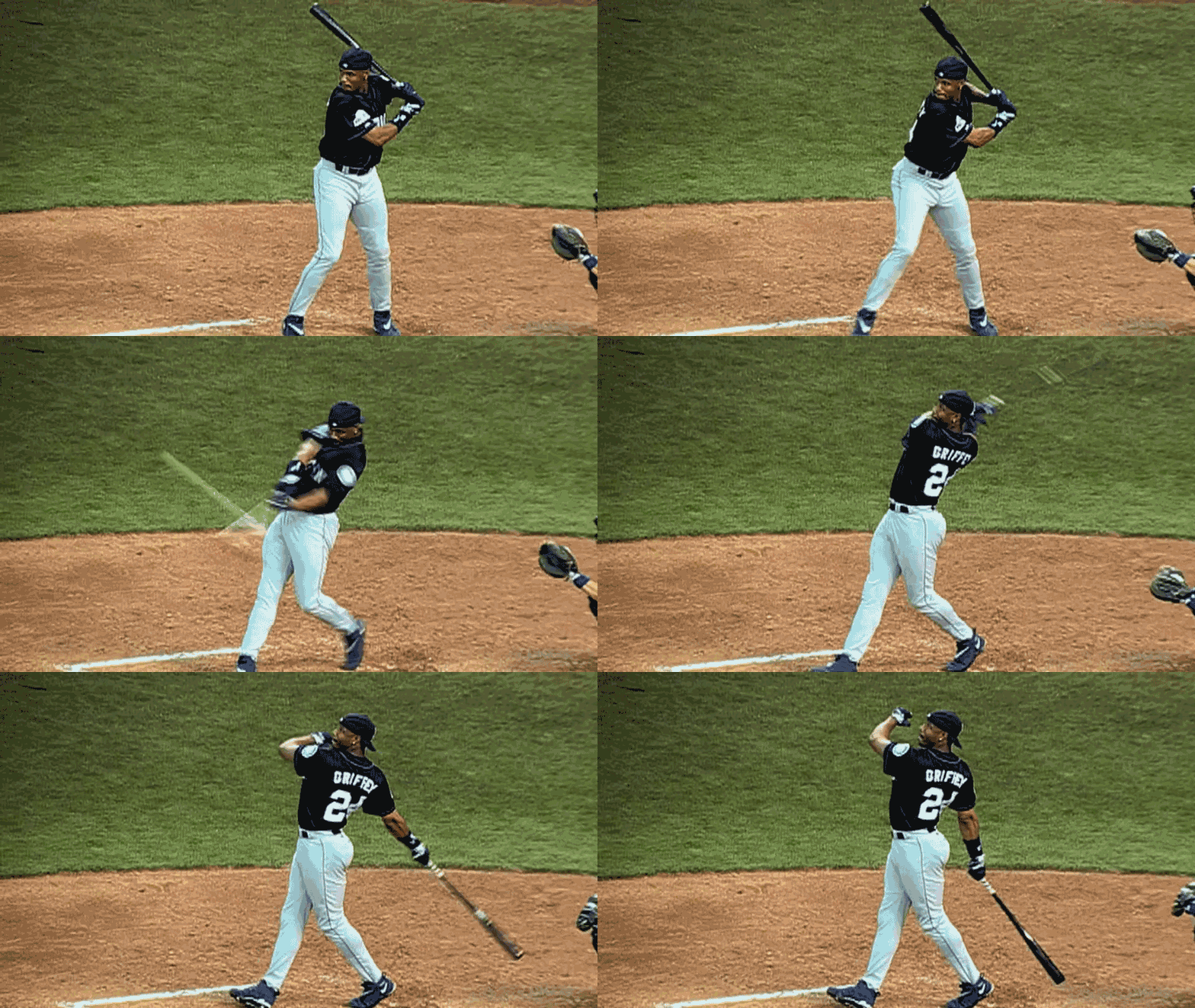
“I copied Griffey’s swing for eight straight years. The only thing I ever hit was my own batting helmet.”
Every Kid Born Between 1975 and 1990
Want to stay up to date with the news and resources from EdwardsSchoen?
Sign up for our monthly newsletter to stay in the know!
Ted Williams – The Perfect Swing
#1 and #2 could be interchangeable. Trust me, I get it. But, anyone whose swing is still as iconic today as it was after WWII … as it was before WWII … deserves the edge up.
It’s only fitting that we begin and end this list with guys who stopped playing to go fight a war, then return as if nothing happened. Ipso facto — Williams and Musial remain the standard — and their swings are nearly identical.
The mechanics were textbook. The balance was flawless. The understanding of hitting was decades ahead of his time.
Williams treated hitting like a science while everyone else was still guessing. His swing reflected that approach.
Smooth. Direct. Powerful. Efficient.
The closest thing baseball has ever had to a blueprint.
If you built the perfect hitter in a laboratory, the swing would probably look suspiciously familiar.
And, Ted’s cryogenic head might still be available??

“Most hitters guessed. Ted Williams had already read the book, skipped to the last chapter, and spoiled the ending.”
Old-Timey Pitcher — Like Field of Dreams Old
Honorable Mentions
Ichiro Suzuki :: The only player who could turn an infield single into performance art.
Manny Ramirez :: Looked casual. Produced Hall of Fame-level terror.
Reggie Jackson :: A swing built specifically for October.
Jeff Bagwell :: Crouching Batter. Hitting Bombs.
Frank Thomas :: A defensive tackle with incredible swing mechanics.
Willie Stargell :: The follow-through alone belongs in a museum.
⚾ Final Thoughts
read in the style of Lou Brown while lighting a cigarette he wasn’t supposed to have
The best baseball swings aren’t always technically perfect.
Sometimes they’re weird. Sometimes they’re unconventional. Sometimes they make hitting coaches nervous. But the truly memorable swings share one thing in common: they look inevitable.
The moment the hitter starts moving, you know something good is about to happen.
And for those of us who grew up watching Griffey launch moonshots, McGriff quietly punish mistakes, Thome rearrange stadium architecture, and Pujols terrorize pitchers for two decades, those swings are more than mechanics.
They’re nostalgia. They’re summer nights. They’re the crack of the bat coming through a tube television speaker.
And if you’re a certain age, they’re also a reminder that your favorite players are now eligible for senior discounts.
Just like you.
“People say hitting a baseball is the hardest thing in sports. That’s not true. The hardest thing in sports is explaining to your wife why your ERA went up three runs in June.”
Anonymous pitcher after facing Griffey, Thome, Pujols, Sheffield, and McGriff in the same month
** Fun Fact
The Rest of the Story
It’s summer 1995. You’re starting shortstop on a state championship contending High School baseball team. You’re feeling your oats. It’s a hot, muggy, dusty July afternoon. Perfect weather for Springfield’s annual Forth of July Tournament. You draw a rival Kansas City area team to play on your home field*. While you’ve had your share of scouts at various games, the stands this day are packed with scouts from nearly every top college and MLB team. You have no idea why, but this is a very popular annual tournament with top teams from all over the region, so you go on about your business.
A few innings go by, and the game is packed with action on both sides: hits, stolen bases, diving plays, near-miss home runs, double plays — the works.
*It’s about now I should mention that your home field has very unique dimensions. While it now has a regular shape, back then, Glendale High School’s outfield was shared with the soccer team, and thus shaped more like a rectangle (outlined in red).
LF (335′) – LCF (436′) – CF (395′) – RCF (360′) – RF (310′) with the school not far beyond the fence.
This was not the nice arced outfield fence most every other stadium in the baseball universe has! So, for a right-handed hitter, pulling the ball for a home run was rare. OK, back to the story.

As the game got into the late innings, Glendale was up by a few runs. Then a stalky, bulked-up, goteed young hitter steps to the plate. The kind of player coaches joke about asking for a birth certificate … but for good reasons! He had been at bat a few times with no great success, but this time the story changed. With one swing of the bat, our highly contested game turned into a slow-motion movie montage of every player, coach, scout and fan standing, watching, and gawking at a baseball disappear faster and farther than we’d thought possible!!
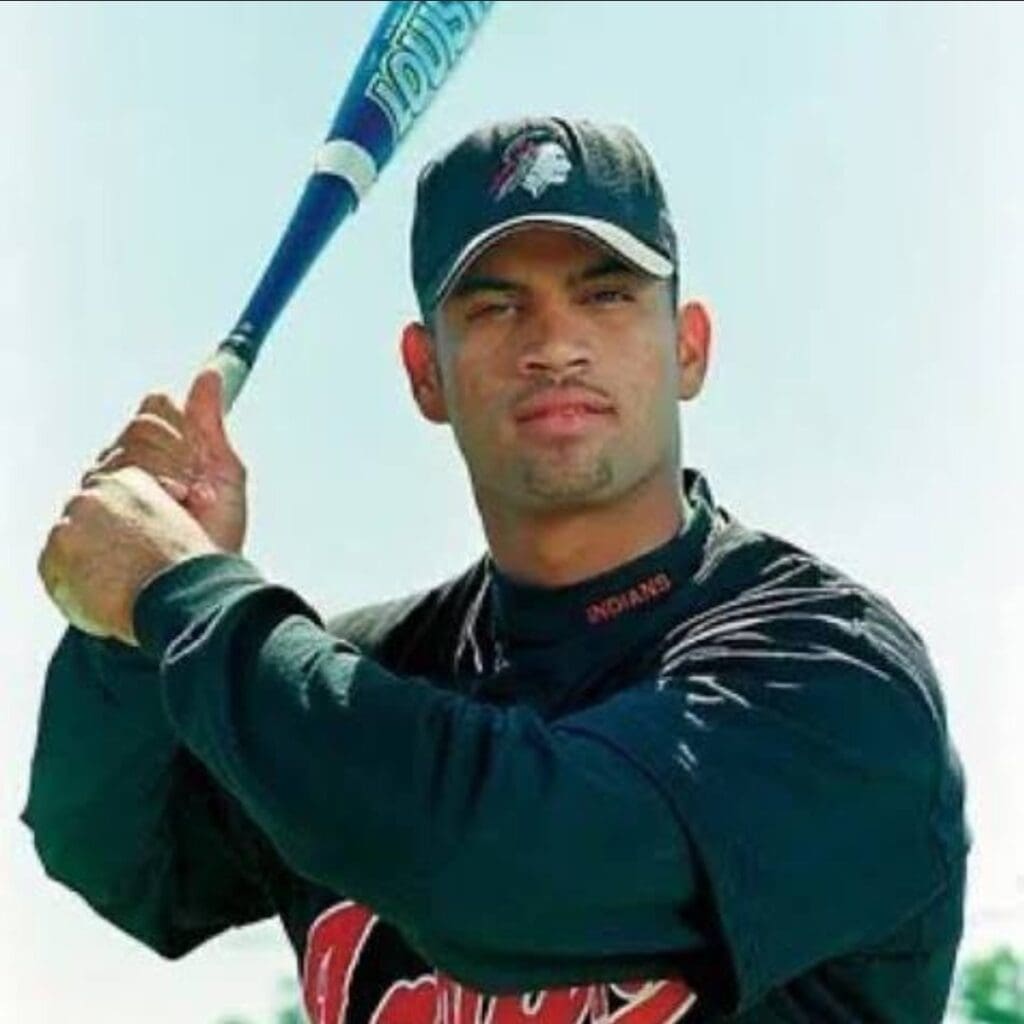
This, sports fans, was Dominican Republic’s own freshman (yeah, right) Albert Pujols playing for Independence Hi-Boy Baseball and Fort Osage High School. He hit the ball dead straight to LCF; well over the 436′ sign; at least 50-60 more feet beyond and hit. the. school!!
It was in that moment, we knew why all the MLB and College scouts were in the stands! He would go on to amass 703 home runs, just as legitimate as that one in July 1995, during his 22 year playing career.

