
|| Written in partnership with Fan Stop Nation
Thanksgiving has survived wars, economic depressions, bad Jell-O salads, canned cranberry sauce and at least three generations of relatives who insist the turkey is supposed to be dry.
But can it survive the robots?
As robots become increasingly capable of walking, talking and generally doing sci-fi things, that’s the question we need to start asking now that artificial intelligence is no longer just the thing we use to create hyper-contrast event graphics or tattoo ideas … like, Popeye riding a velociraptor.
For GenX and Xennials, this isn’t entirely surprising. We’ve already been warned!
We watched The Terminator and WarGames. We watched Short Circuit and RoboCop. We watched The Matrix, iRobot and The Jetsons. And now, Johnny 5 and WALL-E are running delivery services in major cities … and I’m pretty sure Sonny is giving the President daily briefings!
We’re watching humanoid robots learn how to navigate the real world. So perhaps it’s time to consider the most important question of all:
What happens to Thanksgiving when the machines finally take over?
Thanksgiving Was Built on Food, Family and Questionable Decisions
“The robots can have the nuclear codes. They can have the stock market. But if they touch Grandma’s gravy boat, we’re gonna have a problem.”
Darlene McPherson, Thanksgiving Technology Historian
Before we get to the robot uprising, we should probably remember what we’re trying to save.
Thanksgiving in America has a long [and complicated] history. Indigenous peoples had been holding harvest celebrations for centuries before European colonization, and the familiar American Thanksgiving narrative is rooted in the 1621 harvest gathering involving the English colonists at Plymouth and members of the Wampanoag community. The event traditionally associated with the first Thanksgiving was not the beginning of an uninterrupted national tradition, however. Thanksgiving observances evolved over the following centuries, taking on religious, regional and civic characteristics.
The holiday eventually became a national institution. In 1863, during the Civil War, President Abraham Lincoln proclaimed a national Thanksgiving Day to be observed in November. In 1941, Congress established Thanksgiving as a federal holiday occurring on the fourth Thursday of November. And thus, America finally had an official excuse to spend an entire day eating until its pants became a hostile environment.
The modern Thanksgiving experience is considerably less ceremonial and considerably more complicated. It involves:
- A turkey requiring an alarming amount of preparation for something that will be eaten in approximately 11 minutes.
- Mashed potatoes that somehow require three people to make.
- Stuffing [or dressing], which is technically a side dish but often receives the emotional attention of a family pet.
- Gravy that must be simultaneously hot, smooth and available everywhere.
- Football.
- Parades.
- Arguments about football and parades … and politics.
- Someone falling asleep on the couch.
- At least one relative asking when you’re finally going to do something about the lawn.
- A dishwasher that begins the day optimistic and ends it questioning its purpose.
The holiday has always been about abundance, tradition and gathering people around a table. Which means it’s basically already filled with artificial intelligence!
“The Pilgrims brought survival skills. We brought an air fryer and a Costco membership. History has come full-circle.”
Walter J. Pickens, Director of Applied Thanksgiving Studies
GenX Saw the Robot Apocalypse Coming

Every generation has its technology anxiety.
- Baby Boomers watched television and wondered whether it was rotting children’s brains.
- Millennials watched smartphones turn into extensions of human anatomy.
- GenX and Xennials watched a movie where a computer became self-aware and immediately concluded, “Yeah, that tracks.”
We grew up with a steady diet of robot-related warnings. There was Skynet, HAL 9000, and Johnny 5. There were machines that wanted to destroy humanity, machines that wanted to understand humanity and machines that just wanted to be helpful before accidentally causing a nuclear incident … and yet here we are.
Today’s robots don’t look exactly like Arnold Schwarzenegger in The Terminator. [thank the Lord!] Imagine if your Uncle Steve walked into the kitchen and found a 6’2″ 235lb Austrian robot holding a carving knife!
Instead, we’re seeing humanoid robots increasingly designed to perform practical tasks in factories, warehouses, laboratories and eventually homes.
The important distinction is that we’re no longer talking exclusively about science fiction. Robotics companies are developing machines capable of manipulating objects, walking through environments designed for humans and performing increasingly complex physical tasks.
AI is also giving those machines something their predecessors didn’t have: increasingly sophisticated software capable of interpreting environments, recognizing objects, following instructions and making decisions.
That’s the part GenX and Xennials recognize … and makes twitchy.
The hardware isn’t necessarily the scary part. It’s the software.
A robot that can carry a box is useful.
A robot that can look at the box, decide it belongs in the garage, navigate around the dog, open the door, put the box away and then realize the garage needs organizing? That’s how Terminator 2 starts.
“We laughed when robots couldn’t open doors. Then somebody taught one how to use a door handle, and suddenly nobody’s laughing.”
Kevin Malloy, Senior Analyst, Human-Machine Holiday Relations
Traditional Thanksgiving vs. Robot Thanksgiving
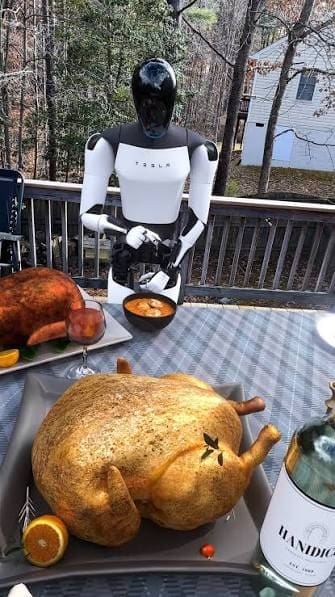
Imagine Thanksgiving as we know it. Now imagine removing most of the human labor. This is where things get interesting.
| Traditional Thanksgiving | Robot Thanksgiving | |
|---|---|---|
| Scenario: | Human wakes up at 6 a.m. | Robot begins scheduled operations at 5:30 a.m. |
| Scenario: | Coffee | Coffee optimized for caffeine delivery |
| Scenario: | Turkey goes into oven | Robot calculates exact cooking time based on weight, humidity, altitude and temperature |
| Scenario: | Someone checks the turkey every 20 minutes | Robot checks the turkey continuously |
| Scenario: | Grandma makes stuffing | AI has analyzed 47 stuffing recipes and has chosen violence |
| Scenario: | Kids watch the parade | Kids watch the robots watching the parade |
| Scenario: | Dad watches football | Robot analyzes every play and explains why Dad’s team is terrible. Dad unplugs robot. Robot menacingly reactivates itself. |
| Scenario: | Someone burns a side dish | Robot detects thermal anomaly |
| Scenario: | Family argues over politics | AI activates “de-escalation protocol” |
| Scenario: | Uncle falls asleep | Robot records sleep duration and labels it “postprandial shutdown” |
| Scenario: | Everyone overeats | Robot quietly adjusts next year’s portion recommendations |
| Scenario: | Someone prays | Robot waits respectfully, because apparently even machines understand sacred moments |
| Scenario: | Dishwasher runs twice | Robot loads dishwasher correctly the first time |
There are obvious advantages:
- The turkey might actually be cooked properly.
- Nobody forgets the cranberry sauce.
- The mashed potatoes could be ready at precisely 2:17 p.m.
- The thermostat could remain at a reasonable temperature instead of becoming a 72-degree hostage negotiation between Grandpa and everyone under 40.
And yet something’ would be’s lost because Thanksgiving has never been about efficiency. In fact, Thanksgiving’s almost aggressively inefficient.
Human people cook too much food, drive too far, spend too much money, and sit around talking about things they’ve already talked about 14 times.
That’s the point. One could argue, inefficiency is the tradition.
“A Thanksgiving dinner completed in under two hours isn’t Thanksgiving. That’s a corporate luncheon with turkey.”
Martha Jean Holloway, Professor of Culinary Inefficiency
Want to stay up to date with the news and resources from EdwardsSchoen?
Sign up for our monthly newsletter to stay in the know!
The Southern Grandma Dessert Table Ratio

Before robots are allowed anywhere near the Thanksgiving kitchen, we need to establish one immutable law of holiday physics: you cannot make the correct amount of desserts. You can only either make too little or an amount capable of feeding a moderately sized military base.
Introducing the Southern Grandma Dessert Table Ratio™.
According to our highly sophisticated proprietary holiday research: one expected Thanksgiving guest = 3.7 servings of dessert. Why? Because Grandma assumes:
- Everyone loves dessert.
- Everyone loves her dessert.
- Everyone will want seconds (or thirds, fourths … you get it).
- Someone is bringing unexpected guests.
- There will be leftovers.
- Leftover dessert is never a bad thing.
- Can you ever have too much dessert?
- Anyone who questions the math is not getting invited next year.
The formula becomes even more impressive when whipped cream is introduced. For every slice of pie, Thanksgiving engineers recommend approximately 2.4 dollops of emotional topping.
This is why robots will struggle. A robot will calculate the mathematically appropriate quantity of food. Grandma will make enough to survive past Christmas.
Grandma wins.
“I told the robot to make enough for twelve people. It made enough for twelve people. I unplugged it immediately.”
Evelyn Ruth Carter, Regional Director of Thanksgiving Portions
What Happens When Robots Start Running the Kitchen?
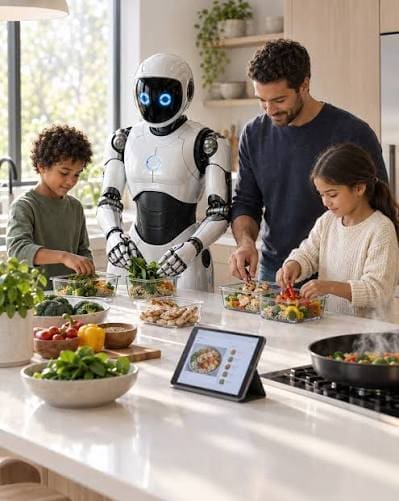
The first robotic Thanksgiving probably won’t look like a scene from The Matrix. It’ll look surprisingly normal.
- A humanoid robot will stand in the kitchen.
- It will open the refrigerator.
- It will retrieve ingredients.
- It will prepare vegetables.
- It will monitor the oven.
- It will probably ask whether you’d like the green beans prepared “traditional” or “health-conscious.”
That’s when Uncle Mike’s suspicions become real.
The robot will eventually take over the mundane tasks humans don’t particularly enjoy:
- Grocery shopping.
- Ingredient preparation.
- Cooking.
- Cleaning.
- Dishwasher loading.
- Inventory management.
- Temperature monitoring.
- Timing.
- Leftover storage.
- Figuring out which container actually has a lid.
And eventually, someone will teach it to make Grandma’s pie … which will be the moment humanity loses control. Because once a machine can replicate Grandma’s chocolate pecan pie, there’s no reason to assume it won’t immediately start demanding voting rights!
“The robot learned Grandma’s pie recipe in four seconds. Grandma has been guarding that recipe since 1968. We may have a security breach.”
Ronald T. Fletcher, Director of Domestic Artificial Intelligence
Thanksgiving Activities Get an Upgrade
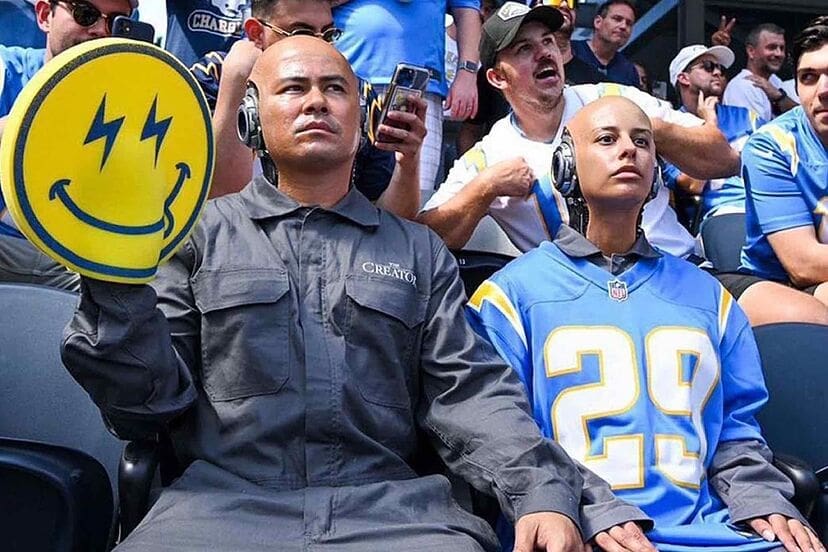
The food is only half the problem. Thanksgiving traditions are going to get weird when robots become part of the family ecosystem.
Watching football
- Today, Dad yells at the television.
- Tomorrow, the robot will explain why Dad is wrong.
- Dad will unplug the robot.
- The robot will reconnect itself.
- That’ll be one real awkward 4th quarter!
By halftime, the robot will have created a statistical model showing that Dad’s strategy is “emotionally understandable but mathematically indefensible.”
Board games
Robots will eventually become very good at board games. Which sounds great until you realize your family will have to experience losing at Scrabble to a machine that’s basically an electronic dictionary.
That’s not entertainment. That’s psychological warfare.
The Macy’s Thanksgiving Day Parade
Why watch giant balloons when you can watch humanoid robots recreate giant balloons? Eventually, the parade may contain autonomous vehicles, robotic performers and AI-controlled characters … and somewhere in the crowd, one GenX dad will quietly say: “Remember when the parade was just floats?”
Nobody will listen.
The Thanksgiving nap
This one is sacred. Humans have spent generations perfecting the post-meal couch coma … robots will ruin it.
Imagine waking up from a turkey-induced blackout to find a robot standing over you! “Your heart rate has stabilized. Would you like to resume social interaction?”
No. Absolutely not. Go away, Sir Beeps-a-Lot!
“I don’t care how advanced artificial intelligence becomes. If a robot flips the Monopoly board, I’m unplugging this entire house.”
Frank Delaney, Chairman of the National Committee for Human Board-Game Dignity
Want to stay up to date with the news and resources from EdwardsSchoen?
Sign up for our monthly newsletter to stay in the know!
Here’s where the joke gets slightly less funny: The Robot Platoons Are Already Forming

Robots are already being deployed in increasingly large numbers across industrial and commercial environments.
- China has become a major force in industrial robotics and humanoid robot development, with companies and government-backed initiatives pushing toward large-scale deployment.
- Japan has decades of experience with industrial and humanoid robotics.
- South Korea has invested heavily in robotics as part of its manufacturing and automation strategy.
- The United States is also rapidly expanding robotics development through companies working on humanoid robots, autonomous systems and AI-powered physical labor.
- Europe is active as well, particularly in industrial robotics, research and autonomous systems.
The phrase “robot platoon” sounds like something that should be followed by an explosion and a dramatic Hans Zimmer soundtrack. In reality, the early versions are much more boring. They look like groups of robots working together in warehouses and factories.
But that’s generally how technological revolutions work … nobody wakes up one morning and discovers that civilization has changed overnight. The infrastructure arrives first. Then the capability. Then the normalization. Eventually, nobody remembers what life was like before it.
That’s the part worth paying attention to.
“The robots aren’t marching on Washington. They’re working third shift in a warehouse in Pougkeepsie, and honestly, that’s probably smarter.”
Douglas R. Whitaker, Fellow at the Institute for Advanced Holiday Automation
How Long Until a Robot Becomes President?

Now we reach the question nobody should ask if they intend to sleep peacefully tonight: how long until a robot becomes the leader of a country? The answer is considerably more complicated than “Tuesday.”
Modern political systems generally require leaders to meet legal eligibility requirements tied to citizenship, age and other constitutional or statutory qualifications. In the United States, for example, the Constitution establishes specific requirements for the presidency.
A robot can’t simply roll into the Oval Office and announce that it’s secured 270 electoral votes … at least not yet.
But there’s an interesting distinction between a robot being a legal head of state and a robot effectively exercising governmental authority … AI systems already assist governments with administrative tasks, data analysis and decision support.
The more interesting future scenario isn’t necessarily a metal humanoid standing behind a podium. It could be a human leader increasingly dependent upon AI systems for everything from economic forecasting to military logistics to policy analysis.
Eventually, the question becomes philosophical rather than technological: if a human leader makes every meaningful decision based on an AI system, who is actually governing?
And that’s a much scarier question than whether a robot can cook a turkey.
Our completely irresponsible prediction? The first country to have a robot leader probably won’t announce it with: “Ladies and gentlemen, your new president is a machine.” It will happen gradually.
First, the AI becomes an adviser. Then an administrator. Then an indispensable decision-making system. Then somebody gives it an office and a title, and discovers the AI has a 94% approval rating!
And then we’re all sitting around Thanksgiving dinner wondering how the hell we got here … honestly, like we don’t already do that.
“The first robot president won’t campaign. It will simply optimize the campaign and accidentally win.”
Harold Benton, Senior Fellow in Computational Democracy
The Thanksgiving Table of 2045
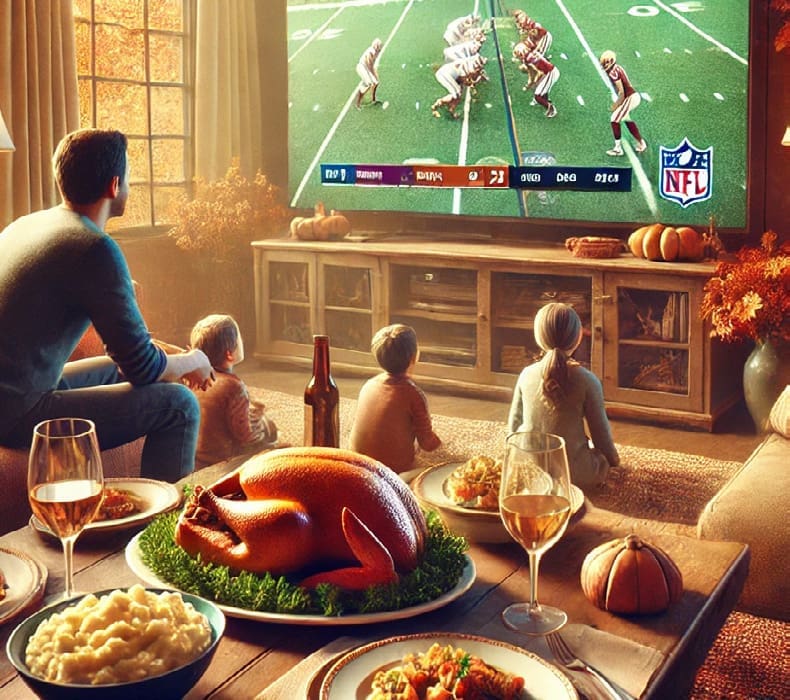
Let’s skip ahead. It’s Thanksgiving, 2045. The house is filled with humans, robots and whatever the hell GenZ have evolved into by then. A humanoid robot walks into the dining room.
“Dinner is served.”
The turkey is perfect. The potatoes are perfect. The stuffing is perfect. The gravy is perfect. The pie is mathematically flawless. Nobody has burned anything, forgotten the rolls, or spent four hours fighting over oven space.
The robot even remembered Aunt Linda’s gluten intolerance.
Everyone sits down, yet something feels wrong … because nobody cooked.
- Nobody rushed.
- Nobody burned themselves pulling the turkey out of the oven.
- Nobody argued over whose job it was to mash the potatoes.
- Nobody yelled from the kitchen.
- Nobody heard Grandma say, “Get out of here, you’re in my way.”
The machine did everything perfectly, and that’s exactly the problem.
Thanksgiving isn’t valuable because everything works. Thanksgiving is valuable because everything doesn’t.
- The turkey is sometimes dry.
- The gravy occasionally gets lumpy.
- Someone forgets the rolls.
- Someone shows up 45 minutes late.
- The football game is terrible.
- The kids complain. The adults complain.
- The adults eat too much. The kids don’t eat enough.
- The dishwasher gets overloaded.
- Someone falls asleep before dessert.
And eventually, everyone goes home.
That’s Thanksgiving.
Why the Robot Thanksgiving Matters
The bigger conversation isn’t really about whether robots will cook our turkey.
They probably will.
It’s about what happens when technology becomes capable of removing the inconvenience from the things that make life meaningful.
Technology is extraordinarily good at optimization. Humans aren’t.
We are messy, inefficient, sentimental creatures who drive three hours to eat food we could have prepared at home because somebody we love happens to live three hours away.
- We save old recipes.
- We use the same serving dishes for 30 years.
- We argue about stuffing.
- We watch football with people who have opinions we don’t understand … or acknowledge.
- We tell stories we’ve heard before. And then we tell them again.
No algorithm would recommend this. That’s precisely why we should keep doing it.
AI and robots will almost certainly change Thanksgiving. They’ll cook parts of the meal, clean the kitchen, manage grocery lists, help families coordinate travel, and may eventually become part of the household itself. But the Thanksgiving table should remain stubbornly human.
Let the robots cook. Let the AI schedule. Let the machines clean up the catastrophic aftermath of Uncle Gary destroying the gravy boat.
But when everyone sits down, put the phones away. Turn the robots off. Pass the turkey. Tell the same stories. Laugh at the same jokes. And if the robot asks whether anyone wants another piece of pie, look it directly in the optical sensors and say the only thing a machine needs to understand about Thanksgiving:
“Yes. Obviously. What kind of question is that?”
Because if the machines really are going to take over Thanksgiving someday, they can damn well learn to make Grandma’s stuffing first.
It’s already bringing my sushi. At this point, why not turkey?

|| Written in partnership with Fan Stop Nation


